DocumentationConfiguring feesFixed, percentage & caps
Fixed, percentage & caps
Four fields decide what a payment fee comes to: a fixed amount, a percentage, and a minimum and maximum that keep the percentage inside a range. This page says what each one does and which combinations stores actually use.
The four fields
Four fields on each payment method decide the amount. Fill in one of the first two, or both.
| Field | What it does |
|---|---|
| Fixed fee | Added to every order paid with this method. May be negative. |
| Percentage fee | A share of the calculation base: the subtotal, plus the cart’s tax unless you untick that box. Checkboxes add shipping and other fees, or subtract coupons. May be negative. |
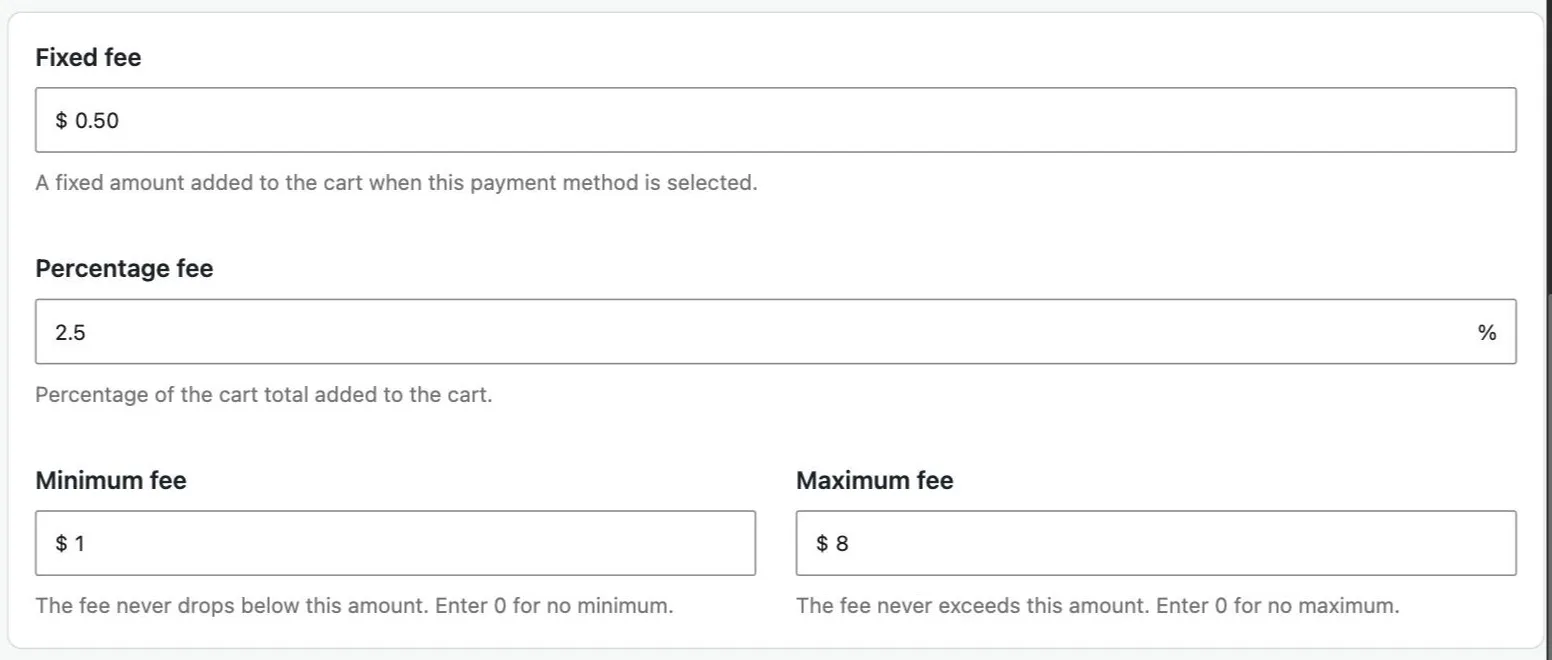
| Minimum | The fee may not come out below this. Appears once a percentage is entered. |
| Maximum | The fee may not come out above this. Same. |
The fixed amount and the percentage are added together first; the caps clamp the sum; tax comes after. The order is always the same and is written out on how the amount is calculated.
Three common shapes
Flat. A fixed 2.00 and nothing else. Simple, but it lands unevenly: 5 % of a 40 basket, and barely noticeable on a 900 one.
Percentage with a ceiling. 1.4 % + 0.25, maximum 8. What a card processor charges you, passed on — and the cap means a 5,000 basket carries 8, not 70.
Percentage with a floor and a ceiling. 2.5 % + 0.50, minimum 1, maximum 8. The cash-on-delivery rule: the floor covers the courier’s handling charge on tiny orders, the ceiling stops a large one paying for the privilege.
When the caps apply
Only to a rule that has a percentage. A fixed-only fee is never clamped — there is nothing for a cap to protect you from, since the amount cannot vary. A zero in either cap means “no bound”, not a bound of zero. The minimum cannot conjure a fee out of nothing either: a rule that works out to zero is dropped before the caps run.
The caps are bounds on the result, which matters for discounts: the bound that limits a −2 % discount is itself negative. That is on the discounts page.
Read next
A different rule for large baskets, or for export orders, is a second rule with a condition — which is Pro.
See what Pro adds